
What is torch nn Really
Just an exploration on what PyTorch actually is and the preface for each module actually existing.
MNIST Setup
The document I am referencing is https://docs.pytorch.org/tutorials/beginner/nn_tutorial.html it uses the MNIST Dataset to make its point.
from pathlib import Path
import requests

DATA_PATH = Path("data")
PATH = DATA_PATH / "mnist"

PATH.mkdir(parents=True, exist_ok=True)

URL = "https://github.com/pytorch/tutorials/raw/main/_static/"
FILENAME = "mnist.pkl.gz"

if not (PATH / FILENAME).exists():
  content = requests.get(URL + FILENAME).content
  (PATH / FILENAME).open("wb").write(content)
import pickle
import gzip
# The dataset is in pickle format, which is a python serializable large file format
with gzip.open((PATH / FILENAME).as_posix(), "rb") as f:
((x_train, y_train), (x_valid, y_valid), _) = pickle.load(f, encoding="latin-1")from matplotlib import pyplot
import numpy as np
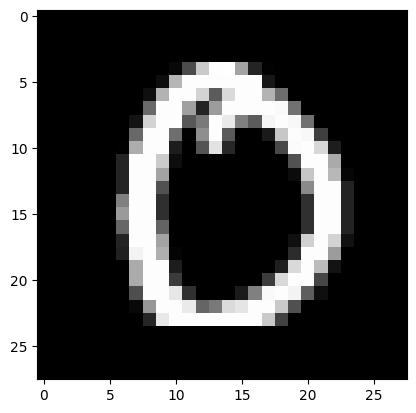
# Dataset is just a bunch of 28x28 pixel written numbers, just basic of the basic OCR
pyplot.imshow(x_train[88].reshape((28, 28)), cmap="gray")
pyplot.show()Output:
<Figure size 640x480 with 1 Axes>
import torch
from functools import partial

device = 'cuda' if torch.cuda.is_available() else 'cpu'

# PyTorch uses a special datatype for operations, hence we convert the data to tensor
x_train, y_train, x_valid, y_valid = map(
  partial(torch.as_tensor, device=device),
  (x_train, y_train, x_valid, y_valid)
  )
print(x_train.shape, x_train.device)
print(y_train.shape, y_train.device)
print(x_valid.shape, x_valid.device)
print(y_valid.shape, y_valid.device)
Output:
torch.Size([50000, 784]) cuda:0
torch.Size([50000]) cuda:0
torch.Size([10000, 784]) cuda:0
torch.Size([10000]) cuda:0
Gradients
One powerful thing about PyTorch is that it can calculate gradients automatically. This is done with requires_grad=True.
import math

# "It works because It works" type initialization of model weights(called an Xavier Initialization)
# Well actually it has some statistical backing, to limit the chances of exploding and vanishing gradients,
# we keep te variance in activation and gradient the same
weights = torch.randn(size=(784, 10), device=device) / math.sqrt(784)  # one shot MNIST
weights.requires_grad_() # this needs to be done because / math.sqrt(784) made a new tensor!!!!!
bias = torch.zeros(10, device=device, requires_grad=True)
Small Aside on Xavier Initialization
Problem: Keep variance constant across layers during forward/backward pass.
Forward pass: For , assuming independence and zero mean:
\text{Var}(y) = n_{in} \cdot \text{Var}(w) \cdot \text{Var}(x)$$ **Goal:** $\text{Var}(y) = \text{Var}(x)$ requires:n_{in} \cdot \text{Var}(w) = 1 \implies \text{Var}(w) = \frac{1}{n_{in}}
n_{out} \cdot \text{Var}(w) = 1 \implies \text{Var}(w) = \frac{1}{n_{out}}
\text{Var}(w) = \frac{2}{n_{in} + n_{out}}
W_{ij} \sim \mathcal{N}\left(\mu = 0, \sigma = \sqrt{\frac{2}{n_{in} + n_{out}}}\right)
\frac{1}{\sqrt{n_{in}}}
```python # Lets define some raw python functions on these tensors def log_softmax(x): return x - x.exp().sum(-1).log().unsqueeze(-1) def model(x_batch): return log_softmax(x_batch @ weights + bias) ``` This is a single layer model that takes in all the input pixels, and outputs a value for the 10 classes (which a softmax is then applied to get a final classification score). ```python batch_size = 64 x_batch = x_train[:batch_size] preds = model(x_batch) preds[0], preds.shape ``` **Output:** ``` (tensor([-2.6786, -2.4870, -2.2257, -2.0464, -2.1061, -2.3727, -1.7868, -2.7828, -2.5606, -2.4143], device='cuda:0', grad_fn=<SelectBackward0>), torch.Size([64, 10])) ``` ```python # implement negative log-likelihood def nll(input, target): return -input[range(target.shape[0]), target].mean() loss_func = nll y_batch = y_train[:batch_size] print(loss_func(preds, y_batch)) ``` **Output:** ``` tensor(2.3618, device='cuda:0', grad_fn=<NegBackward0>) ``` ```python # implement accuracy def accuracy(out, y_batch): preds = torch.argmax(out, dim=1) return (preds == y_batch).float().mean() print(accuracy(preds, y_batch)) ``` **Output:** ``` tensor(0.1250, device='cuda:0') ``` Using what has been written from scratch, we can build a training loop ```python # Training loop lr = 0.5 epochs = 2 n, c = x_train.shape training_loss = [] for e in range(epochs): for i in range((n - 1) // batch_size + 1): # Build a batch start_i = i*batch_size end_i = start_i + batch_size x_batch = x_train[start_i:end_i] y_batch = y_train[start_i:end_i] # Run forward pred = model(x_batch) loss = loss_func(pred, y_batch) loss.backward() # Update using .data attribute with torch.no_grad(): weights -= weights.grad * lr # Ok something inside Tensor Class makes this not work anymore bias -= bias.grad * lr weights.grad.zero_() bias.grad.zero_() # Its a shitty model, but you can see that the loss decreased and the accuracy increased print(loss_func(model(x_batch), y_batch), accuracy(model(x_batch), y_batch)) ``` **Output:** ``` tensor(0.0651, device='cuda:0', grad_fn=<NegBackward0>) tensor(1., device='cuda:0') ``` # Refactoring the Code The raw computation can be quite the hassle, especially if we want to build more complex networks, or share modules with other people. As a result, PyTorch abstracts alot of this raw pythonic operations away so that you can have a better time. ## `torch.nn.functional` This contains all the functions for the `torch.nn` library. That includes a handful of activation and loss functions. - our `negative log likelihood` function can be replaced with `F.cross_entropy` - our `log softmax` function can be replaced with `F.cross_entropy` ```python import torch.nn.functional as F loss_func = F.cross_entropy # redefine model to no longer call log_softmax def model(x_batch): return x_batch @ weights + bias print(loss_func(model(x_batch), y_batch), accuracy(model(x_batch), y_batch)) ``` **Output:** ``` tensor(0.0651, device='cuda:0', grad_fn=<NllLossBackward0>) tensor(1., device='cuda:0') ``` ## `nn.Module` Speaking on model, we can abstract it away from the training loop to make things more clear and concise. `nn.Module` is a base class that lets you define the weights, bias, and forward propagation of a model. It also has a number of useful attributes like `parameters(), state_dict(), zero_grad()`. ```python from torch import nn class MNISTLogistic(nn.Module): def __init__(self, device): super().__init__() self.weights = nn.Parameter(torch.randn(size=(784, 10), device=device) / math.sqrt(784)) self.bias = nn.Parameter(torch.zeros(10, device=device)) # bias initialized as zeros def forward(self, x: torch.Tensor) -> torch.Tensor: return x @ self.weights + self.bias model = MNISTLogistic(device=device) print(loss_func(model(x_batch), y_batch)) ``` **Output:** ``` tensor(2.3749, device='cuda:0', grad_fn=<NllLossBackward0>) ``` Because `nn.Module` has useful attributes `.paramters()` and `.zero_grad()`, updating the weights and biases previously and manually zeroing out the gradients for each weights and biases can now be abstracted into... ```python def fit(): for e in range(epochs): for i in range((n-1) // batch_size + 1): # Build a batch start_i = i*batch_size end_i = start_i + batch_size x_batch = x_train[start_i:end_i] y_batch = y_train[start_i:end_i] # Run forward pred = model(x_batch) loss = loss_func(pred, y_batch) loss.backward() # just update the parameters and zero the grad for the whole model with torch.no_grad(): for p in model.parameters(): p -= p.grad * lr model.zero_grad() fit() print(loss_func(model(x_batch), y_batch)) ``` **Output:** ``` tensor(0.0654, device='cuda:0', grad_fn=<NllLossBackward0>) ``` ## nn.Linear (and other layers) Instead of manually defining weights and bias, theres a useful python class `nn.Linear` that makes one for us. PyTorch has a bunch of other useful layers that can be used. ```python class MNISTLogistic(nn.Module): def __init__(self, device=None): super().__init__() self.linear = nn.Linear(in_features=784, out_features=10, device=device) def forward(self, x: torch.Tensor) -> torch.Tensor: return self.linear(x) model = MNISTLogistic(device) print(loss_func(model(x_batch), y_batch)) fit() print(loss_func(model(x_batch), y_batch)) ``` **Output:** ``` tensor(2.3214, device='cuda:0', grad_fn=<NllLossBackward0>) tensor(0.2296, device='cuda:0', grad_fn=<NllLossBackward0>) ``` # `torch.optim` This abstracts away optimization. We can call `step()` instead of manually updating all of our parameters with the gradient. ```python from torch import optim def get_model(): model = MNISTLogistic(device) return model, torch.optim.SGD(model.parameters(), lr=lr) # YOU PASS IN YOUR MODEL PARAMETERS TO THE OPTIMIZER model, opt = get_model() for e in range(epochs): for i in range((n - 1) // batch_size + 1): # build batch start_i = i * batch_size end_i = start_i + batch_size x_batch = x_train[start_i:end_i] y_batch = y_train[start_i:end_i] # predict pred = model(x_batch) loss = loss_func(pred, y_batch) opt.zero_grad() loss.backward() opt.step() print(loss_func(model(x_batch), y_batch)) ``` **Output:** ``` tensor(0.0829, device='cuda:0', grad_fn=<NllLossBackward0>) ``` ## Dataset PyTorch provides an abstract dataset class to manage data. TensorDataset provides a direct indexing lookup of the data. ```python from torch.utils.data import TensorDataset train_ds = TensorDataset(x_train, y_train) model, opt = get_model() for e in range(epochs): for i in range((n - 1) // batch_size + 1): x_batch, y_batch = train_ds[i * batch_size: i*batch_size + batch_size] pred = model(x_batch) loss = loss_func(pred, y_batch) opt.zero_grad() loss.backward() opt.step() print(loss_func(model(x_batch), y_batch)) ``` **Output:** ``` tensor(0.0830, device='cuda:0', grad_fn=<NllLossBackward0>) ``` ## DataLoader Works in tandem with Dataset to allow for batched loading of data. ```python from torch.utils.data import DataLoader train_dl = DataLoader(train_ds, batch_size=batch_size) for e in range(epochs): for x_batch, y_batch in train_dl: # very nice :) pred = model(x_batch) loss = loss_func(pred, y_batch) opt.zero_grad() loss.backward() opt.step() print(loss_func(model(x_batch), y_batch)) ``` **Output:** ``` tensor(0.0662, device='cuda:0', grad_fn=<NllLossBackward0>) ``` # Add Validation There hasn't been any validation yet, so should implement it. ```python train_ds = TensorDataset(x_train, y_train) train_dl = DataLoader(train_ds, batch_size=batch_size) val_ds = TensorDataset(x_valid, y_valid) val_dl = DataLoader(val_ds, batch_size=batch_size) for e in range(epochs): model.train() for x_b, y_b in train_dl: pred = model(x_b) loss = loss_func(pred, y_b) opt.zero_grad() loss.backward() opt.step() model.eval() with torch.inference_mode(): val_loss = sum(loss_func(model(x_b), y_b) for x_b, y_b in val_dl) / len(val_dl) print(e, val_loss) ``` **Output:** ``` 0 tensor(0.2795, device='cuda:0') 1 tensor(0.2786, device='cuda:0') ``` # Create fit() and get_data() This is more of a design decision. If you want to can abstract everything to make it like three scripts. ```python def batch_loss(model, loss_func, x_b, y_b): pred = model(x_b) return loss_func(pred, y_b) def get_data(train_ds, val_ds): return ( DataLoader(train_ds, batch_size=batch_size, shuffle=True), DataLoader(val_ds, batch_size=batch_size * 2), ) def fit(epochs, model, loss_func, opt, train_dl, val_dl): for e in range(epochs): model.train() for x_b, y_b in train_dl: loss = batch_loss(model, loss_func, x_b, y_b) opt.zero_grad() loss.backward() opt.step() model.eval() with torch.inference_mode(): val_loss = sum(batch_loss(model, loss_func, x_b, y_b) for x_b, y_b in val_dl) / len(val_dl) print(e, val_loss) train_dl, val_dl = get_data(train_ds, val_ds) fit(10, model, loss_func, opt, train_dl, val_dl) ``` **Output:** ``` 0 tensor(0.2233, device='cuda:0') 1 tensor(0.3145, device='cuda:0') 2 tensor(0.2947, device='cuda:0') 3 tensor(0.2699, device='cuda:0') 4 tensor(0.3732, device='cuda:0') 5 tensor(0.6905, device='cuda:0') 6 tensor(0.2980, device='cuda:0') 7 tensor(0.2964, device='cuda:0') 8 tensor(0.3577, device='cuda:0') 9 tensor(0.2735, device='cuda:0') ``` # Making this thing actually work The whole model is a single linear layer at the moment, lets actually set this model up for success. One way is to introduce convolutional layers to the network. These will learn kernels (filters) that are convoluted (rolling dot-product window) over the image to recognize patterns. These patterns and their location then provide a better classification for vision in general. ```python class MNISTCNN(nn.Module): def __init__(self, device=None): super().__init__() self.conv1 = nn.Conv2d(1, 16, kernel_size=3, stride=2, padding=1, device=device) self.conv2 = nn.Conv2d(16, 16, kernel_size=3, stride=2, padding=1, device=device) self.conv3 = nn.Conv2d(16, 16, kernel_size=3, stride=2, padding=1,device=device) def forward(self, x : torch.Tensor) -> torch.Tensor: x = x.view(-1, 1, 28, 28) # -1 means "infer this dimension automatically" x = F.relu(self.conv1(x)) x = F.relu(self.conv2(x)) x = F.relu(self.conv3(x)) x = F.avg_pool2d(x, 4) return x.view(-1, x.size(1)) # Momentum is a variation of SGD which is aware of past updates to help with the current update (hence momentum) model = MNISTCNN(device) opt = torch.optim.SGD(model.parameters(), lr=0.05, momentum=0.9) fit(10, model, loss_func, opt, train_dl, val_dl) ``` **Output:** ``` 0 tensor(0.5407, device='cuda:0') 1 tensor(0.3209, device='cuda:0') 2 tensor(0.2648, device='cuda:0') 3 tensor(0.2313, device='cuda:0') 4 tensor(0.1830, device='cuda:0') 5 tensor(0.1886, device='cuda:0') 6 tensor(0.1700, device='cuda:0') 7 tensor(0.1602, device='cuda:0') 8 tensor(0.1453, device='cuda:0') 9 tensor(0.1497, device='cuda:0') ``` # `nn.Sequential` This is just a quicker way to define a model. idk why people do this. ```python class Lambda(nn.Module): def __init__(self, func, device=None): super().__init__() self.func = func def forward(self, x): return self.func(x) def preprocess(x): return x.view(-1, 1, 28, 28) model = nn.Sequential( Lambda(preprocess), nn.Conv2d(1, 16, kernel_size=3, stride=2, padding=1, device=device), nn.ReLU(), nn.Conv2d(16, 16, kernel_size=3, stride=2, padding=1, device=device), nn.ReLU(), nn.Conv2d(16, 16, kernel_size=3, stride=2, padding=1, device=device), nn.ReLU(), nn.AvgPool2d(4), Lambda(lambda x: x.view(x.size(0), -1)), ) opt = optim.SGD(model.parameters(), lr=0.05, momentum=0.9) fit(10, model, loss_func, opt, train_dl, val_dl) ``` **Output:** ``` 0 tensor(0.5411, device='cuda:0') 1 tensor(0.3231, device='cuda:0') 2 tensor(0.2601, device='cuda:0') 3 tensor(0.2159, device='cuda:0') 4 tensor(0.2040, device='cuda:0') 5 tensor(0.1843, device='cuda:0') 6 tensor(0.1636, device='cuda:0') 7 tensor(0.1547, device='cuda:0') 8 tensor(0.1656, device='cuda:0') 9 tensor(0.1423, device='cuda:0') ```