
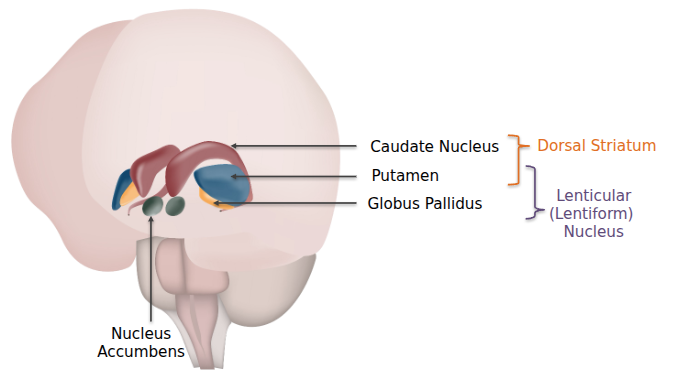
Basal Ganglia
- Components: caudate nucleus, putamen, globus pallidus, nucleus accumbens.
- Functions:
- Movement control (initiation, inhibition).
- Habit learning, reward, motivation (connects to addiction pathways).
- Cognitive flexibility (switching responses).
- Disorders:
- Parkinson’s: substantia nigra degeneration → movement deficits (loss of dopamine neurons).
- Huntington’s: caudate/putamen degeneration → involuntary movements.
- Tourette’s: dysregulated basal ganglia circuits → tics.
The basal ganglia is responsible for learning from positive and negative reinforcement. It has two pathways:
- Go Pathway responsible for positive reinforcement learning
- ACTIVATED BY DOPAMINE, LEARNS FROM DOPAMINE SPIKES
- NoGo Pathway responsible for negative reinforcement learning
- INHIBITED BY DOPAMINE, LEARNS FROM DOPAMINE DIPS
Its important to note that the amount do dopamine and the change in dopamine are both important. The amount of dopamine determines whether the Go or NoGo pathways function at all. The change in dopamine determines when these pathways learn. So a high concentration of dopamine means the Go pathways will function really well, but the nogo pathway will basically not function at all. So we would end up learning from positive reinforcement better and negative reinforcement worse. The same things occurs vice versa with low amounts of dopamine.
brain forebrain diencephalon basalGanglia reinforcementLearning