
Camera Calibration
We seek to discover the intrinsic parameters of a camera. There are various approaches to do this.
Setup
I got some pretty shitty images of a checkerboards.
import cv2
import numpy as np
import matplotlib.pyplot as plt

import glob
image_paths = glob.glob('images/*.png')
images = []
for path in image_paths:
img = cv2.imread(path)
if img is not None:
images.append(img)
else:
print("No images found, or failed to load")
# Convert BGR to RGB for matplotlib
images_rgb = [cv2.cvtColor(img, cv2.COLOR_BGR2RGB) for img in images if img is not None]
# Display in a grid
n_images = len(images_rgb)
cols = 5 # Number of columns
rows = 2
plt.figure(figsize=(15, 3 * rows)) # Adjust figure size
for i, img in enumerate(images_rgb):
plt.subplot(rows, cols, i + 1)
plt.imshow(img)
plt.title(f'Image {i+1}')
plt.axis('off')
plt.tight_layout()
plt.show()
images[0].shape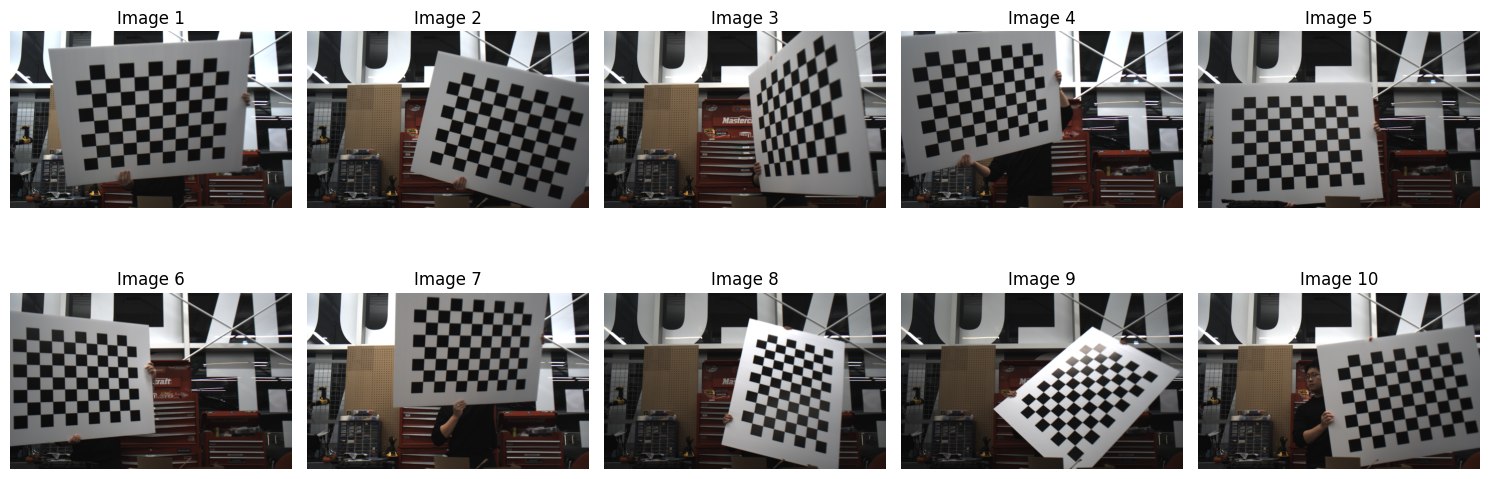
Calibration Time
Using opencv calibration is pretty easy, there’s a built in function
pattern_size = (10, 7)
square_size = 0.0865

# 3D points of checkerboard corners (always the same)
objp = np.zeros((pattern_size[0] * pattern_size[1], 3), np.float32)
objp[:, :2] = np.mgrid[0:pattern_size[0], 0:pattern_size[1]].T.reshape(-1, 2)
objp *= square_size

# Storage
objpoints = []  # 3D points (same for all images)
imgpoints = []  # 2D points (different per image)

# Process each image
for img in images:
    gray = cv2.cvtColor(img, cv2.COLOR_BGR2GRAY)

    # Find corners
    ret, corners = cv2.findChessboardCorners(gray, pattern_size)

    if ret:
        objpoints.append(objp)  # Same 3D points
        imgpoints.append(corners)  # Different 2D observations

# Calibrate
h, w = images[0].shape[:2]
ret, K, dist, rvecs, tvecs = cv2.calibrateCamera(
    objpoints, imgpoints, (w, h), None, None
)

print(f"Intrinsics K:\n{K}")
print(f"Distortion {dist}")
print(f"Number of extrinsic poses: {len(rvecs)}")  # = number of images
Output:
Intrinsics K:
[[2.15670900e+03 0.00000000e+00 8.10347489e+02]
[0.00000000e+00 2.14267203e+03 5.48028224e+02]
[0.00000000e+00 0.00000000e+00 1.00000000e+00]]
Distortion:
[[ 0.0210893 -0.68716169 -0.00217461 -0.01650779 1.76950328]] Number of extrinsic poses: 10
So I got a pretty shit result, maybe because the checkerboard was warping LOL.
What is it doing under the hood?
Zhang’s Method
- Capture images: Take 10-20 photos of a checkerboard pattern from different angles and distances
- Detect corners: Automatically locate the checkerboard corners in each image
- Establish correspondences: Map 2D image points to 3D world coordinates on the plane
- Compute homographies: Calculate the projective transformation between the plane and each image (This is done with SVD on the linear system produced by our detected corners and correspondances)
- Extract parameters: Use these homographies to solve for camera parameters through closed-form solutions followed by nonlinear optimization
Given our camera model
We let the checkboard be the reference frame, so and our model simplified to
From H = λK[r₁ r₂ t], we can write:
where is a scaling factor which is left over and we have to deal with
So: r₁ = λK⁻¹h₁ and r₂ = λK⁻¹h₂
Since r₁ and r₂ are orthonormal:
- r₁ᵀr₂ = 0 → h₁ᵀK⁻ᵀK⁻¹h₂ = 0
- r₁ᵀr₁ = r₂ᵀr₂ → h₁ᵀK⁻ᵀK⁻¹h₁ = h₂ᵀK⁻ᵀK⁻¹h₂
Let B = K⁻ᵀK⁻¹. Expanding this symmetric matrix:
In terms of intrinsics:
We can represent B as a 6D vector: b = [B₁₁, B₁₂, B₂₂, B₁₃, B₂₃, B₃₃]ᵀ
For each homography H with columns h₁, h₂, h₃, define:
Then: hᵢᵀBhⱼ = vᵢⱼᵀb
The two constraints become: Each image gives 2 equations. With n images:
We solve this linear system with SVD
Vb = 0 where V is the 2n × 6 matrix above.
- Minimum 3 images needed (6 equations for 6 unknowns)
- Compute SVD: V = UΣWᵀ
- Solution: b = last column of W (corresponding to smallest singular value)
- This refers to the principle component where data varies the least
Once you have b = [B₁₁, B₁₂, B₂₂, B₁₃, B₂₃, B₃₃]ᵀ, closed-form extraction:
\lambda = B_{33} - [B_{13}^2 + v_0(B_{12}B_{13} - B_{11}B_{23})]/B_{11} \alpha = \sqrt{\lambda/B_{11}}
\gamma = -B_{12}\alpha^2\beta/\lambda
u_0 = \gamma v_0/\beta - B_{13}\alpha^2/\lambda $$ Now you have **K**! We can also **extract extrinsics** For each image i with homography Hᵢ = [h₁ h₂ h₃]: $$ r_1 = \lambda K^{-1}h_1, \quad r_2 = \lambda K^{-1}h_2, \quad t = \lambda K^{-1}h_3 $$ where λ = 1/||K⁻¹h₁|| (for normalization) $$ r_3 = r_1 \times r_2 $$ Then **$\mathbf{C}_{sw}$ = [r₁ r₂ r₃]** and **$\mathbf{t}_sw$ = t** This lets us recover our full extrinsic matrix and recover from our assumption of $z_{w}=0$ $$ z_{s}\begin{bmatrix} u \\ v \\ 1 \end{bmatrix}=\begin{bmatrix} \alpha & \gamma & c_{u} \\ 0 & \beta & c_{v} \\ 0 & 0 & 1 \end{bmatrix}\begin{bmatrix} \mathbf{C}_{sw} & \mathbf{t}_{sw} \end{bmatrix}\begin{bmatrix} x_{w} \\ y_{w} \\ z_{w} \\ 1 \end{bmatrix} $$