
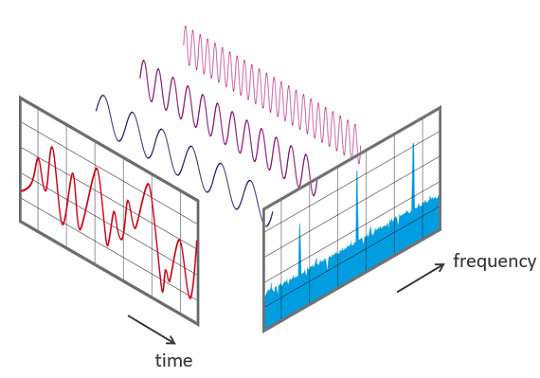
The Fourier Transform comes from the idea that any signal (continuous or discrete) can be represented as a sum of sinusoidal functions at different frequencies (Fourier’s Theorem)
Fourier's Theorem Any periodic signal is composed of a superposition of pure sin waves, with suitably chosen amplitudes and phases.
An extension to Fourier's Theorem is that any signal within a bound can be represented as a superposition of pure sine waves, with suitably chosen amplitudes and phases.
Mathematical Definition
For a continuous function , the Fourier Transform for any frequency is
which is the imaginary number (different conventions in mathematics and engineering). Note: the frequency is a value that we set.
The Inverse Fourier Transform is given as
By Euler’s Formula
Combining both sine and cosine, allowing ups to capture both amplitude and phase at a given frequency
The Fourier Transform is the generalized equation of a Fourier Series. Whereas Fourier Series functions on a set of different indexed frequencies, Fourier Transform functions on a continuous set of frequencies , or in other words, is an entire axis.
When the function is symmetrical, the Fourier Transform has no imaginary part. Otherwise, the Fourier Transform will witness a imaginary part.
This imaginary part of a Fourier Transform is a necessary evil lol. It’s needed in order for the Fourier Transform to be invertible, and to encode timing.
- People usually don’t analyze the imaginary part in isolation, they either
- Ignore it entirely (signal processing)
- Analyze the phase shift (usually shows time delay) and magnitudes (shows the frequency content)