
Continuous Time Stability
Say we have a dynamical system defined as.
if we take the Laplace transform, we get.
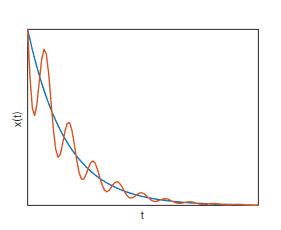
So we have setup a case where we have a transfer function with a single pole. We can use this to analyze how different values of affect the signal. If we give a constant signal to the system…
Case 1:
Case 2:
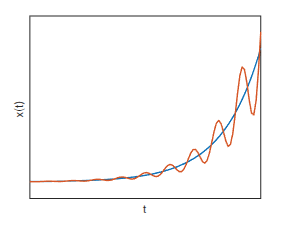 Unstable!!! The pole makes the system explodes!
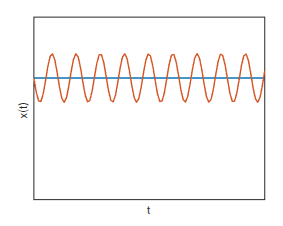
Case 3:
Conclusion
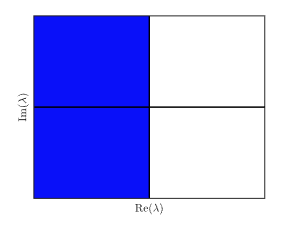
In continuous time, a real, rational, transfer function is stable if all the poles so they lie in the Open Left Hand Plane (OLHP) of the Imaginary Plane
Discrete Time Stability
Now what about discrete time…
We can setup a similar experiment in discrete time with
Taking the Z-transform
We can witness the effects of in discrete time.
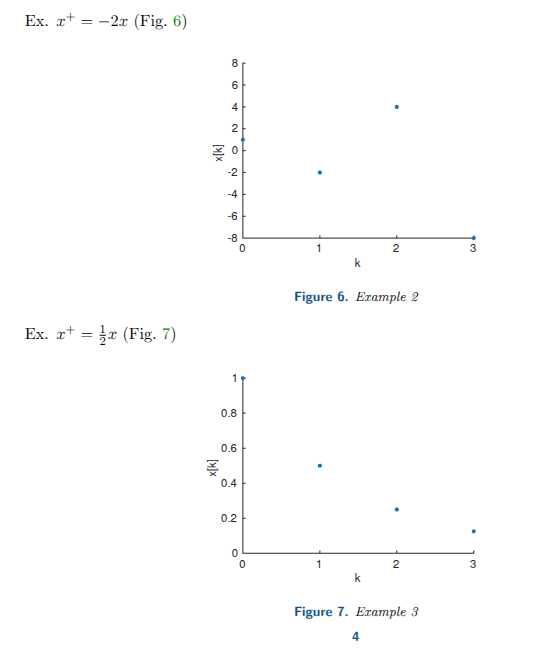 This is telling us that the moment we reach instability.
We say that at is unstable because in practice its really hard to stay at 1. Its more of a convention thing.
Conclusion
In discrete time, **a real, rational, transfer function is stable if all the poles so they lie in the Open Unit Disk
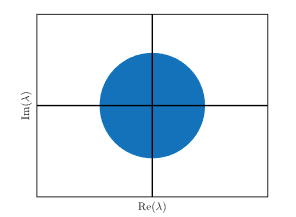
Conclusion
Mixing the two together…
A real, rational transfer function is stable if all poles of lie in (The OLHP) / (The Open Unit Disk).
^^ This is two statements combined into one, OHLP is for continuous, OUD is for discrete.