brain
Action Potentials and Neural Conduction
Historical Background: The Action Potential
- Psychic Pneuma (Herophilus & Galen, ~200 BCE):
- Nerves carried an invisible “air-like” substance responsible for perception and action.
- Thought to flow from brain ventricles into nerves.
- Luigi Galvani (1737–1798):
- Demonstrated that nerves conduct electrical signals.
- Famous frog-leg experiments with static electricity.
- Johannes Müller (1801–1858):
- Law of Specific Nerve Energies: different nerves carry specific types of information (optic nerve → vision, auditory nerve → sound).
- Experience is determined by the pathway, not the stimulus.
- Hermann von Helmholtz (1821–1894):
- Measured speed of nerve conduction.
- Developed the ophthalmoscope, color vision theory, and audition theory.
The Action Potential
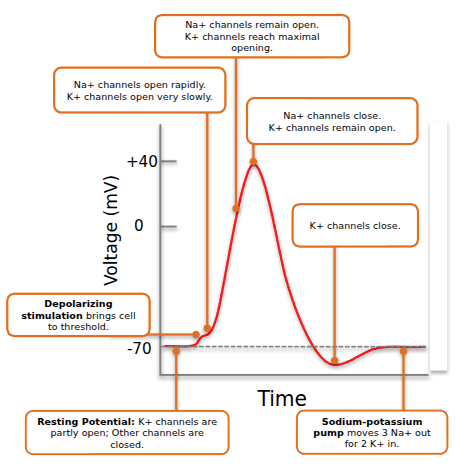
Basics
- Begins at the axon hillock.
- Travels down axon without decreasing in size (non-decremental).
- Is an all-or-none electrical event.
Hodgkin & Huxley (1940s)
- Used the squid giant axon to measure membrane potentials.
- Found:
- At rest: inside = negative (~–70 mV).
- Depolarization beyond a threshold (~–65 mV) triggers an action potential.
Phases of the Action Potential
- Resting Potential – K⁺ channels partly open; Na⁺ channels closed.
- Depolarization – Na⁺ channels open rapidly, Na⁺ floods in. (See Drugs and Pharmacology for how drugs block these channels)
- Rising Phase (Upstroke) – rapid influx of Na⁺.
- Falling Phase (Downstroke) – Na⁺ channels close; K⁺ channels fully open, K⁺ exits.
- Afterhyperpolarization – K⁺ continues leaving, cell becomes more negative than resting.
- Return to Resting – sodium-potassium pump restores gradients (3 Na⁺ out, 2 K⁺ in).
Ion Forces
- Diffusion: ions move down concentration gradients.
- Electrostatic force: opposite charges attract, like charges repel.
Refractory Periods
- Absolute refractory period: no new action potential possible (Na⁺ channels inactive).
- Relative refractory period: requires stronger stimulation (membrane hyperpolarized).
All-or-None Law
- Action potential magnitude is the same, regardless of stimulus strength.
- Stronger stimulus only increases firing frequency, not spike size.
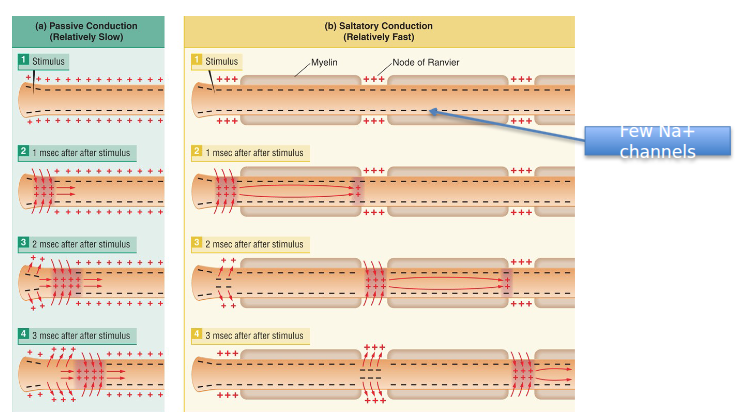
Propagation of the Action Potential
- Moves actively along axon by sequential depolarization of adjacent regions.
- Saltatory conduction: in myelinated axons, AP “jumps” between nodes of Ranvier → faster and more efficient.
- Passive Conduction: in unmyelinated axons, slower
Multiple Sclerosis (MS)
- An autoimmune disorder where the body attacks myelin.
- Results in slower or blocked conduction of nerve impulses.
- Symptoms:
- Muscle weakness
- Sensory problems
- Cognitive deficits
- Course:
- Stage 1: intermittent symptoms.
- Stage 2: progressively worsening.
Genetic Risk
- Higher prevalence among people of European ancestry.
- Numerous genetic variants linked to MS susceptibility.
- Recent research: risk increased in steppe pastoralist populations (historical genetic emergence).
Multiple Sclerosis Mechanism
- MS is an autoimmune disease: the immune system attacks myelin.
- Genetic factors: More common in people of European ancestry; many genetic variants involved.
- Mechanism:
- Leaky blood-brain barrier allows lymphocytes into the brain.
- These, along with microglia, release inflammatory substances.
- Myelin segments break down → disrupts saltatory conduction.
- Downstream of the demyelinated region, the axon withers away and an axonal ovoid is formed
- Gut-brain connection: Dysbiosis (imbalanced microbiome) weakens intestinal wall, allowing microbial products to enter bloodstream → increases inflammation and BBB leakage.
