
Cells of the Nervous System
The Neuron Doctrine
- Competing 19th-century views:
- Reticular Theory (Josef von Gerlach, Camillo Golgi): nervous system is a continuous network.
- Neuron Theory (Ramón y Cajal): nervous system is composed of individual, autonomous cells (“contiguity, not continuity”).
- Cajal’s drawings confirmed neurons are distinct units — this is the Neuron Doctrine, foundation of neuroscience.
Types of Cells in the Brain
- Whole brain: ~170 billion cells
- Neurons: ~86 billion (making up the Grey Matter)
- Glia: ~84 billion (making up the While Matter)
- Ratios vary by region:
- Cerebral cortex: ~16B neurons : 61B glia (~1:3.75)
- Cerebellum: ~69B neurons : 16B glia (~4.3:1)
- Rest of brain: ~0.7B neurons : 7.7B glia (~1:11)
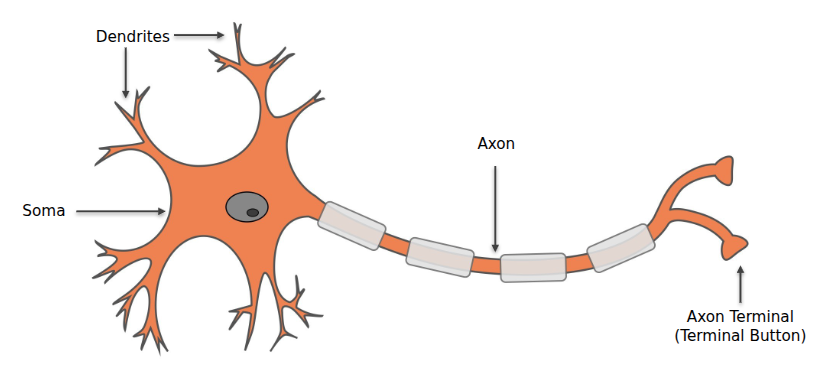
The Neuron
-
Main parts: Soma (cell body), dendrites, axon, axon terminals.
-
Function relates to shape:
- Multipolar neuron – many dendrites, most common in CNS.
- Bipolar neuron – one dendrite, one axon (e.g., retina).
- Unipolar neuron – single process (e.g., sensory neurons).
-
Inside the soma: nucleus, ER, ribosomes, mitochondria, Golgi apparatus, etc.
-
Dendrites: receive input, covered in spines (plastic, motile, change shape in seconds).
- Actin act as the skeleton of the cell, help with shifting the shape of the dendrites.
-
Axon: conducts signals, insulated by myelin with gaps called Nodes of Ranvier.
- At the base of the Axon connecting to the Soma is the Axon Hillock which integrates incoming signals from the dendrites and determining whether to trigger an Action Potentials and Neural Conduction
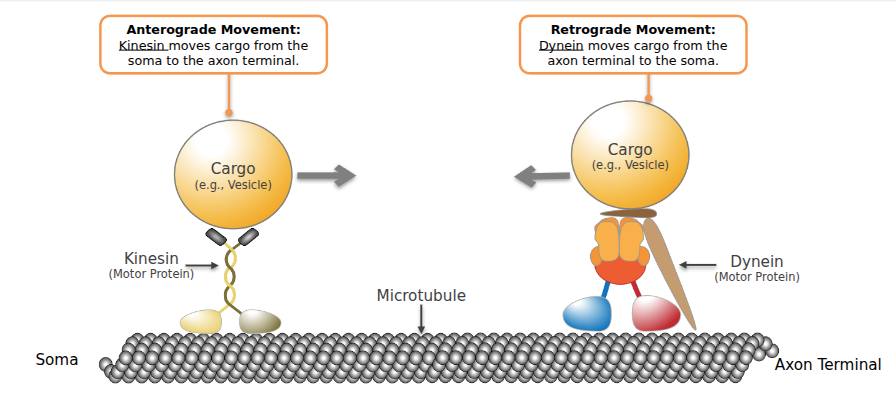
Axonal Transport
- Microtubules serve as “tracks.”
- Kinesin: moves cargo anterograde (from soma → axon terminal).
- Dynein: moves cargo retrograde (axon terminal → soma).
- Ensures neurotransmitters, vesicles, and proteins reach where they’re needed.
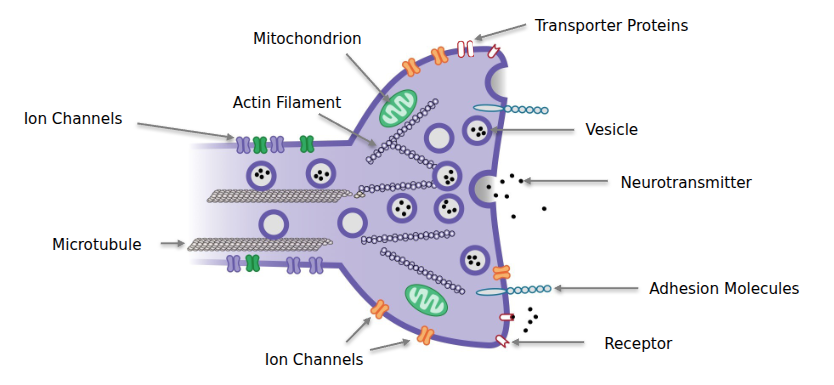
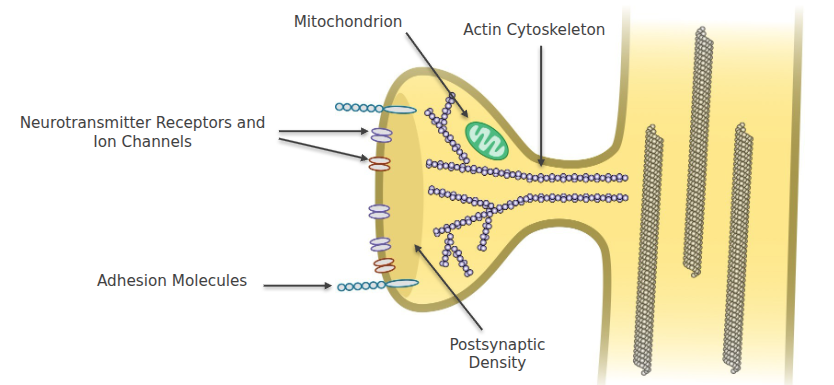
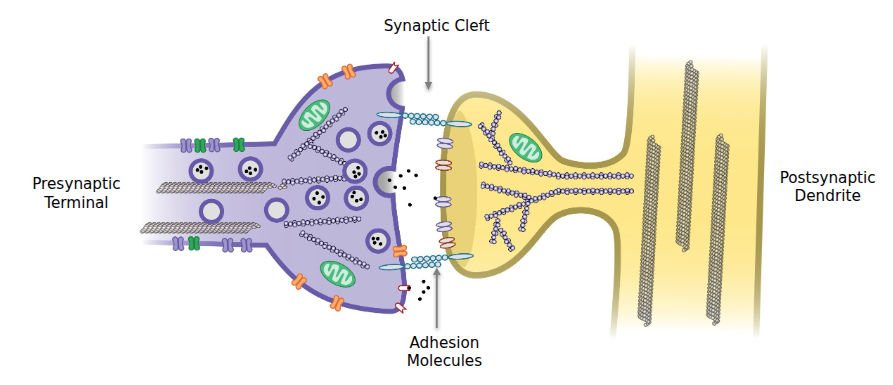
The Synapse
- Coined by Charles Sherrington (1906): neurons are not continuous but communicate at junctions.
- Presynaptic terminal releases neurotransmitters.
- Postsynaptic dendrite receives them via receptors.
- This chemical communication allows flexibility and modulation of signals.
Key distinction
- Efferent axons: carry signals away from a region.
- Afferent axons: carry signals toward a region.
Glia
Not just “support cells” — glia have crucial active roles.
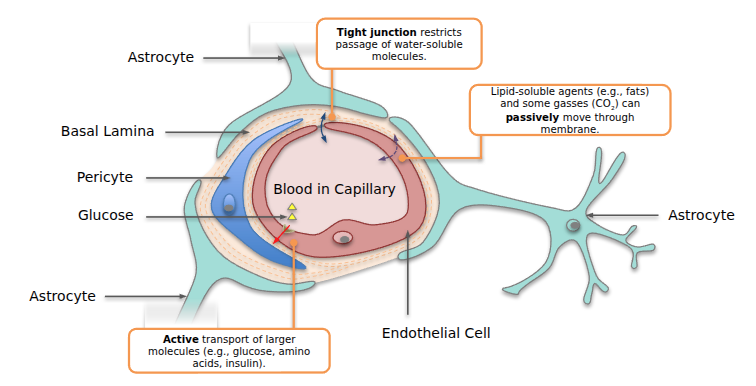
Astrocytes
- Form part of the blood-brain barrier (BBB).
- Tight junctions in capillaries restrict entry of molecules.
- Only lipid-soluble substances (e.g., CO₂, fats) can diffuse freely.
- Larger molecules (e.g., glucose, amino acids, insulin) need active transport.
- Regulate blood flow: dilate/constrict vessels.
- Provide nutrients to neurons.
- Connect with other astrocytes for molecule transfer.
- Create scaffolding that organizes neurons.
- Tripartite synapse: astrocytes wrap around synapses, modulate neurotransmission, and synchronize activity across multiple synapses.
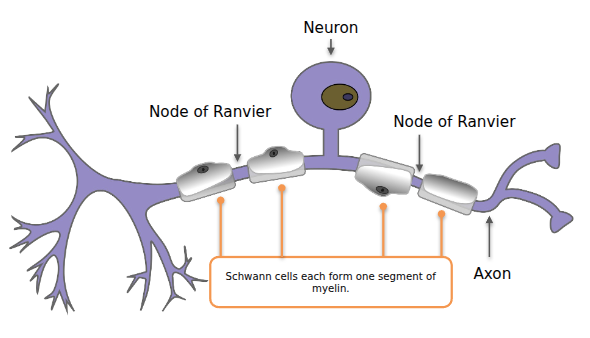
Schwann Cells
- Found in the peripheral nervous system (PNS).
- Each Schwann cell wraps a single segment of one axon with myelin.
- Create nodes of Ranvier between myelinated sections, allowing saltatory conduction.
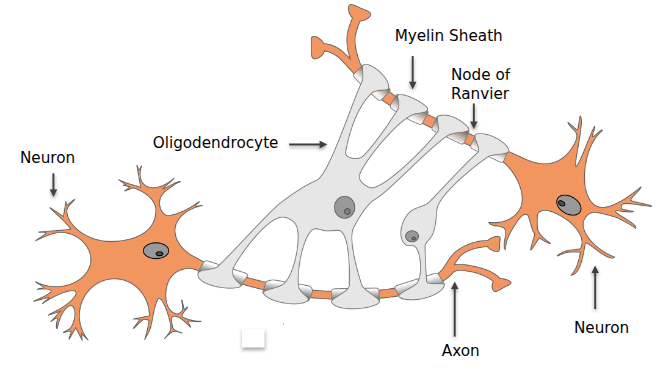
Oligodendrocytes
- Found in the central nervous system (CNS).
- Unlike Schwann cells, one oligodendrocyte can myelinate multiple axons.
- Provide faster, more efficient conduction across the CNS.
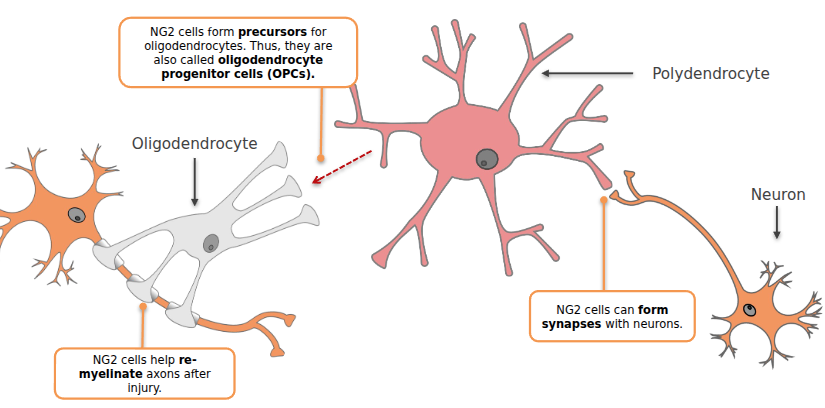
Polydendrocytes (NG2 cells)
- Also called oligodendrocyte progenitor cells (OPCs).
- Functions:
- Can remyelinate axons after injury.
- Act as precursors to new oligodendrocytes.
- Can even form synapses with neurons.
- Their processes cross multiple layers, meaning they may integrate information across grey and white matter.
Microglia
- The immune cells of the CNS.
- Functions:
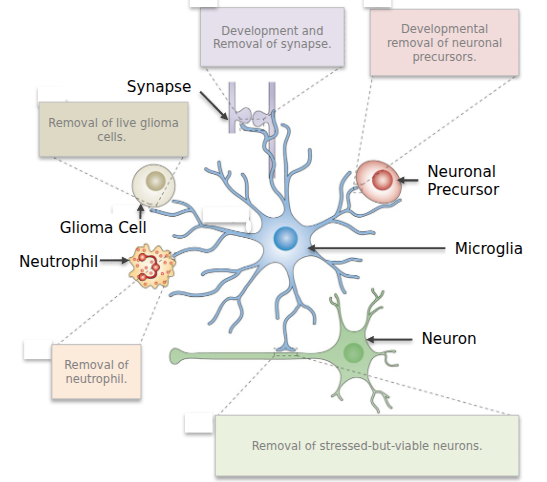
- Remove damaged or dead cells (including glioma tumor cells, precursors, stressed neurons, immune cells like neutrophils).
- In development, prune unnecessary synapses and neuronal precursors.
- Even in adulthood, help reshape synaptic connections (“synaptic stripping”).
Radial Glia
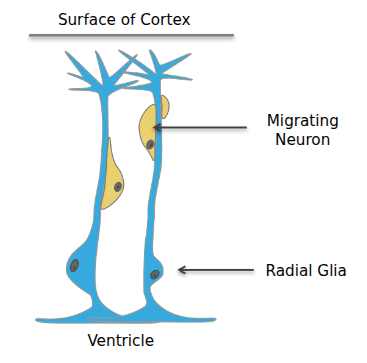
- Act as scaffolds during development.
- Guide migrating neurons from the ventricular zone to the cortex.
- Later in development, many differentiate into neurons or astrocytes.