
There are many types of neurotransmitters. This is because neurons can have different receptors for different neurotransmitters, causing different changes to their action potentials. I had this brief epiphany in Dopaminergic Systems. Its not fundamentally the structure of dopamine that changes how we act, its the receptors and concentration of them in our brain, that just so happen to make dopamine the neurotransmitter responsible for happiness.
When you look at Deep Learning, a single artificial neuron only communicates with a single neurotransmitter. IE. a linear layer outputs a single value! As opposed to an actual neuron, which can spit our different neurotransmitters in different quantities, learning multiple super-imposed models at once... but also keep in mind that the majority (90%) of neurotransmission is done with Glutamate and GABA
Synaptic Transmission and Neurotransmitters
The Synapse
- Communication point between neurons.
- Presynaptic terminal releases neurotransmitters.
- Postsynaptic dendritic spine receives them via receptors.
The Tripartite Synapse
- Classical view: communication is between presynaptic axon terminal and postsynaptic dendritic spine.
- Updated view: astrocytes also play an active role.
- They take up neurotransmitters, release gliotransmitters, and help regulate ionic balance (K⁺, Ca²⁺).
- This creates a tripartite synapse: neuron–neuron–astrocyte.
- Important note: glutamate, though the main excitatory neurotransmitter, can be toxic in excess → leads to excitotoxicity and neuronal death.
Neurotransmitters
Organized into several categories:
Amines
- Catecholamines: derived from phenylalanine → tyrosine → dopa → dopamine → norepinephrine → epinephrine. norepinephrine
- Dopamine pathways originate in midbrain structures (VTA, substantia nigra) dopamine
- Indolamines: from tryptophan → 5-HTP → serotonin → N-acetylserotonin → melatonin. serotonin
- Serotonin neurons concentrated in brainstem raphe nuclei
- Acetylcholine: from choline + acetyl CoA. acetylcholine
- Key in basal ganglia and motor control
Amino Acids
- Glutamate – major excitatory transmitter.
- GABA – major inhibitory transmitter.
- Glycine – another inhibitory transmitter.
Peptides
- e.g., Enkephalins, Substance P, Insulin, Oxytocin.
Gases
- e.g., Nitric oxide (NO), Carbon monoxide (CO).
Other Small Molecules
- e.g., ATP, Adenosine.
Neurotransmitter Release
Steps:
- Neurotransmitter synthesis
- Small molecules synthesized in the terminal.
- Neuropeptides synthesized in the soma and shipped down via fast axonal transport.
- Vesicle loading – neurotransmitters stored in vesicles
- Docking and priming – vesicles attach to the membrane via SNARE proteins.
- Action potential arrival → depolarizes terminal.
- Voltage-gated calcium channels open; Ca²⁺ enters.
- Exocytosis – vesicles fuse and release neurotransmitters.
- Vesicle recycling – endocytosis retrieves vesicle membranes for reuse.
Vesicle Pools:
- Readily Releasable Pool (<1%) – docked and ready.
- Recycling Pool (5–20%) – quickly mobilized.
- Reserve Pool (80–90%) – held in storage.
Postsynaptic Activity
Ligand-Gated Ion Channels
- Neurotransmitters bind to receptors → ion channels open.
- Effects depend on ions:
- EPSP (Excitatory Postsynaptic Potential) – depolarization, brings neuron closer to threshold (e.g., Na⁺ influx).
- IPSP (Inhibitory Postsynaptic Potential) – hyperpolarization, moves neuron further from threshold (e.g., Cl⁻ influx or K⁺ efflux).
Summation
- Temporal Summation: repeated stimulation over time adds up.
- Spatial Summation: simultaneous inputs from multiple presynaptic neurons combine.
Types of Synaptic Receptors
Ionotropic Receptors
- Direct binding site on ion channel.
- Fast, short-lived (e.g., nicotinic ACh receptor, GABA(A), AMPA glutamate receptor).
Metabotropic Receptors
- Work through G-proteins, indirectly influencing ion channels.
- Slower, longer-lasting effects (seconds to minutes).
- Examples: muscarinic ACh receptor, GABA(B), serotonin (5-HT(1A)).
Neurotransmitter Effects
- One neurotransmitter can act on multiple receptor types:
- Acetylcholine: nicotinic (ionotropic), muscarinic (metabotropic).
- GABA: GABA(A) (ionotropic, Cl⁻ channel), GABA(B) (metabotropic, K⁺ channel).
- Glutamate: AMPA (ionotropic, Na⁺), NMDA (ionotropic, Na⁺ & Ca²⁺), metabotropic.
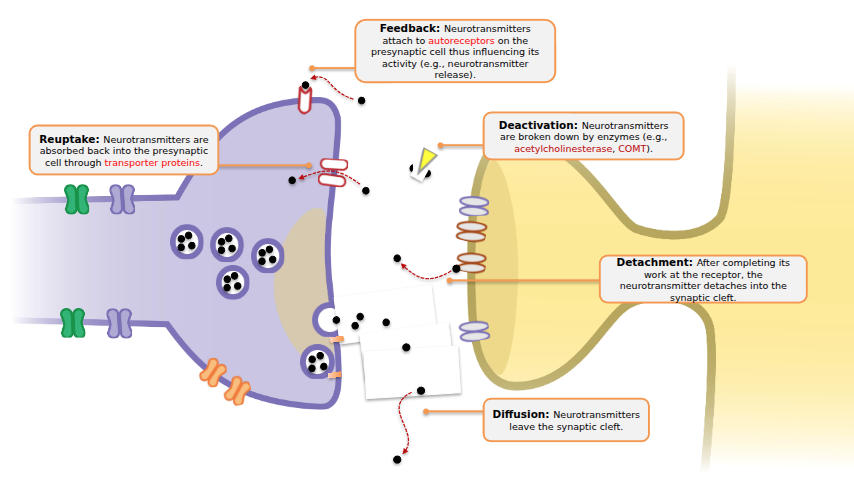
Termination of Neurotransmitter Effects
- Reuptake – neurotransmitter taken back into presynaptic terminal via transporters.
- Enzymatic breakdown – e.g., acetylcholinesterase, COMT.
- Diffusion – neurotransmitter drifts away.
- Autoreceptors – presynaptic receptors that inhibit further release.
- Retrograde transmission – postsynaptic cell releases signals that influence presynaptic release.
Types of Synapses
- Classified by the location of contact:
- Axodendritic: axon → dendrite.
- Axo-somatic: axon → soma.
- Axo-axonic: axon → axon (often modulatory).
The War of the Soups and Sparks
- Early 20th century debate:
- “Sparks” (neurophysiologists) – believed transmission was electrical, based on direct measurements of neuron activity.
- “Soups” (pharmacologists) – believed it was chemical, supported by effects of drugs and toxins (e.g., curare blocking ACh).
- Resolution: both were partly correct.
- Most synapses are chemical, but electrical synapses exist too.
- Nobel Prizes:
- Henry Dale & Otto Loewi (1936) → discovery of chemical neurotransmission.
- John Eccles (1963) → synaptic physiology.
Electrical vs. Chemical Synapses
Electrical Synapses (Gap Junctions)
- Direct physical connections between cells via connexons.
- Allow passage of ions and small molecules directly between cytoplasms.
- Very fast, synchronous communication.
- Found widely across brain regions, often in interneurons.
Chemical Synapses
- Neurotransmitters cross a cleft and bind to receptors.
- Slower but more flexible and modifiable.
Mixed Synapses
- Some synapses combine both electrical and chemical transmission.
- Example: hippocampus synapses with connexin-36 gap junctions coupled with glutamatergic transmission.
Neuropeptides
- Examples: Enkephalins, Substance P, Oxytocin, Insulin.
- Key features:
- Synthesized in the soma (not terminal).
- Often released from dendrites, soma, or axon sides—not just terminals.
- Long half-life (~20 minutes; contrast with ms for classical transmitters).
- Spread to distant targets.
- Functions: modify synapses, alter gene expression, regulate glia.
Gaseous Neurotransmitters
- Nitric oxide (NO) is a key example.
- Small, membrane-permeable → diffuses freely across membranes.
- Can act retrogradely (postsynaptic → presynaptic).
- Regulates synaptic strength, vascular tone, and plasticity.
Co-Transmission
- A single neuron can release multiple types of neurotransmitters.
- Example: one cell might release both a small-molecule transmitter (e.g., glutamate) and a peptide (e.g., substance P).
Neural Circuit Properties
- Convergence: multiple presynaptic neurons synapse onto one postsynaptic neuron.
- Divergence: one presynaptic neuron sends output to multiple postsynaptic neurons.