
Using what we discussed in Rotation Representations
Angular Velocity
The angular velocity of frame 2 with respect to frame 1 is denoted as The angular velocity of frame 1 with respect to frame 2 is denoted as
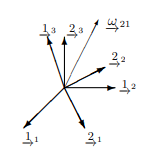
Important Applications
A vector time derivative is the instantaneous rate of change of a vector. Different frames of reference see different motion so we need to analyze the motion of two different frames separately.
In Frame 1
We can define the vector time derivative in frame 1 as . Hence the vector time derivative in frame 1 of frame 1 itself is nothing
Given a angular velocity, , the vector time derivative of frame 2 is given by
Say we have a vector expressed in both frames
The time derivative of such vector from the perspective of Frame 1 is
In Frame 2
We will define the vector time derivative in frame 2 as .
Combining Perspectives (Relationship of Vector Time Derivative)
The vector time derivative of in expressed in terms of frame 2 but as seen in frame 1 is given by
This is telling us how the time derivative of a vector witnessed between two different frames changes based on the angular velocity between two different frames
Inertial Time Derivative
A useful application is when we detect something in a moving frame, and we want to transform it to a non-rotating inertial reference frame (a frame that does not rotate or accelerate, it is often something like the map origin or map reference frame).
Say our rotating frame is undergoing a angular velocity .
First we express the angular velocity
We detected an object in Frame 2 with position . Because Frame 2 is undergoing an angular velocity, the change in the position of the object in the non-rotation inertial frame is given by
Acceleration
A similar formula can be derived for acceleration
note that we are only looking at the instantaneous velocities and accelerations of when the two reference frames are on top of each other and frame 2 in induced with a angular velocity
Angular Velocity Given Rotation Matrix
When our rotation matrix is given as a function of time, our angular velocity is given by: